
Understanding PAM vs CRM in iGaming is important for operators evaluating modern iGaming platform architecture. Both systems work with player data, but they solve different operational problems.
Player Account Management, or PAM, maintains the operational state of the player account. CRM, or Customer Relationship Management, uses player and behavioural data to manage segmentation, communication and engagement.
For operators choosing iGaming platform software, understanding PAM vs CRM in iGaming helps clarify how player operations and engagement should work together.
What is PAM in iGaming?
PAM stands for Player Account Management.
An iGaming PAM is responsible for maintaining the operational player account and the information connected to it.
Typical PAM functionality includes:
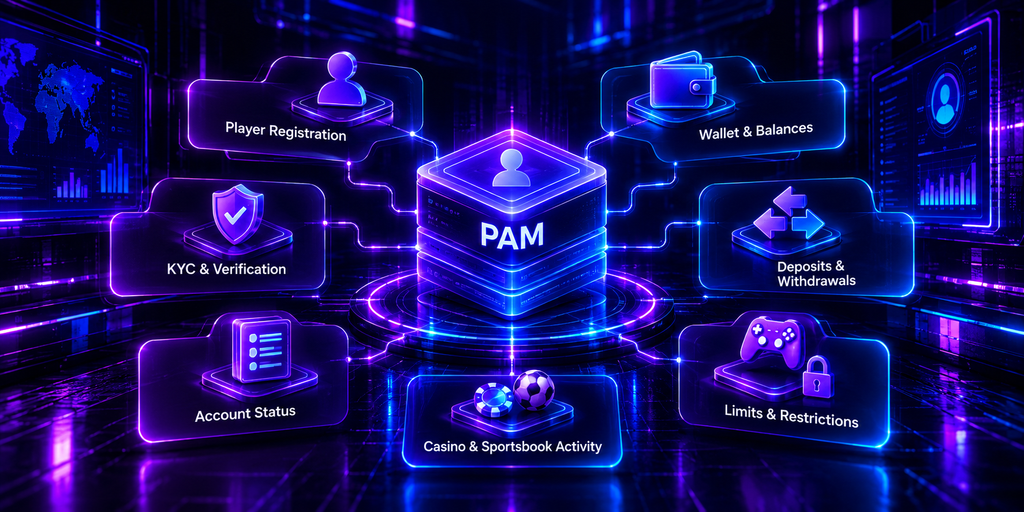
In practical terms, PAM answers operational questions:
Who is the player? Is the account active? What is the current balance? What restrictions apply?
This is the first major distinction when looking at PAM vs CRM in iGaming.
What is CRM in iGaming?
An iGaming CRM focuses on how operators understand, segment and communicate with players.
Typical CRM functionality includes:
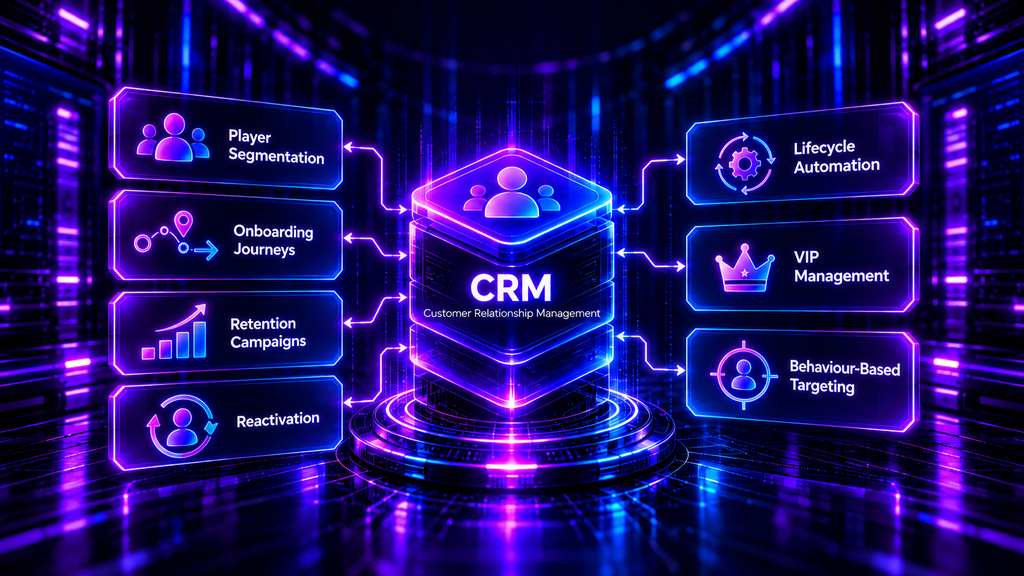
CRM can use signals such as registration, deposits, Casino or Sportsbook activity, inactivity, player value, market and language.
For example, a recently registered player may enter an onboarding journey, while an inactive player may enter a reactivation segment.
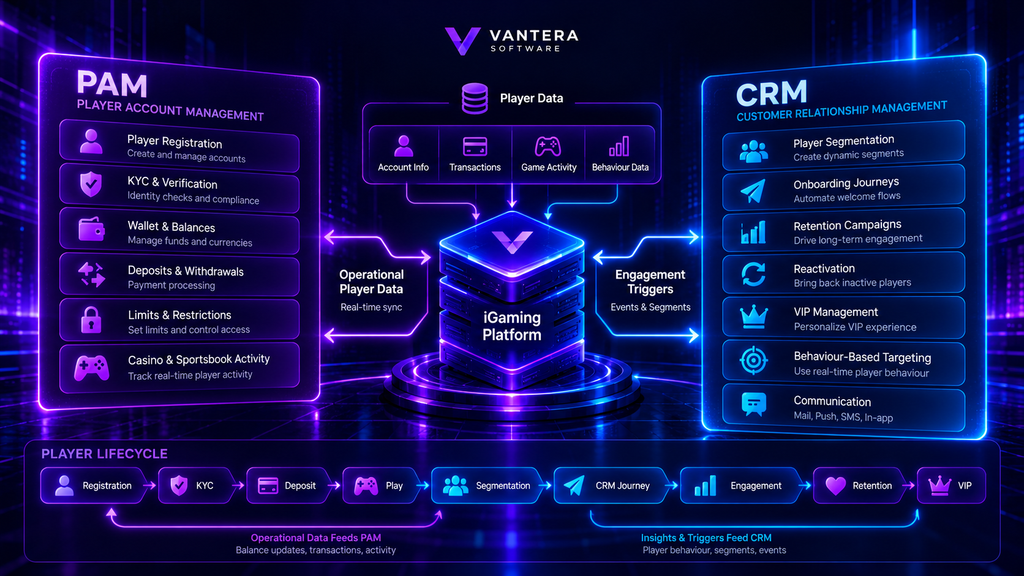
The difference in PAM vs CRM in iGaming is therefore straightforward: PAM manages the operational player account, while CRM manages player engagement.
PAM vs CRM in iGaming: the practical difference
How PAM and CRM work together
A connected platform starts with reliable operational player data.
The PAM creates and maintains the player account. The player deposits funds, uses Casino or Sportsbook products and generates transaction and behavioural data.
The CRM can then use that information for segmentation and engagement.
The flow can be understood as:
Player Account → Activity & Transactions → Segmentation → CRM Journey → Player Interaction
This is where PAM vs CRM in iGaming becomes an architecture question rather than simply a feature comparison.
A CRM should not recreate the player account. Instead, it should work with reliable information provided by the wider platform.
Where Wallet, Payments and controls fit
Wallet and Payments belong to the operational side of the platform.
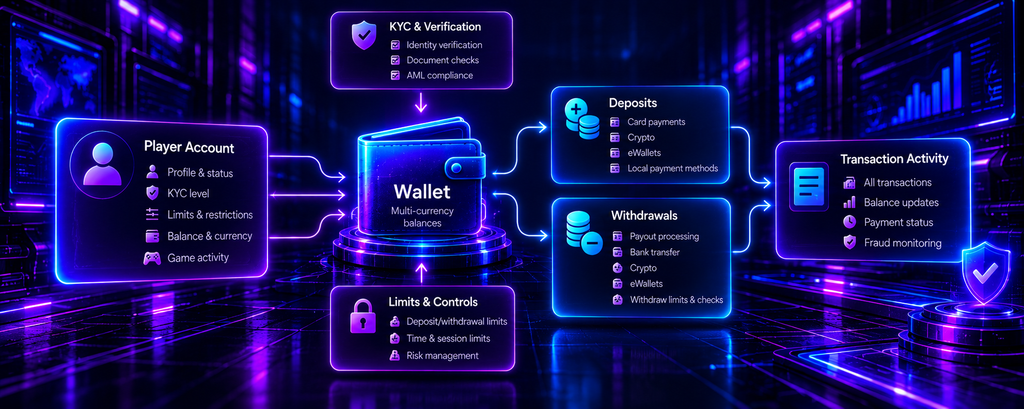
They connect balances, deposits, withdrawals and transaction activity to the player account.
CRM may use payment events as engagement signals, but it should not maintain the actual player balance.
The same principle applies to KYC, limits and operational controls.
Account status, verification and restrictions belong close to the operational player record. CRM should be able to use relevant status information when creating audiences and journeys without becoming the compliance or KYC system itself.
Understanding PAM vs CRM in iGaming helps operators keep these responsibilities clearly separated while still allowing data to move between systems.
Does every operator need both PAM and CRM?
Every operator needs player account management functionality because accounts, balances, transactions and operational states must exist somewhere in the platform.
CRM requirements depend on the operating model.
Some platforms include basic CRM functionality, while others connect a dedicated CRM to PAM and other operational modules.
As an operation grows, teams may require more advanced segmentation, automation, retention, VIP management and lifecycle analytics.
At that stage, PAM vs CRM in iGaming becomes increasingly important because both layers need to scale together.
What operators should evaluate
When reviewing an iGaming platform, operators should look beyond whether a provider simply lists PAM and CRM as features.
More useful questions include:
- Can CRM use current Casino, Sportsbook and payment data?
- Are account restrictions reflected in engagement workflows?
- Can the same player be understood across CRM, Payments, Casino and Sportsbook?
- Can CRM evolve without rebuilding player-account infrastructure?
These questions reveal more about the quality of the platform architecture than the names of individual modules.
PAM and CRM are different layers of the same player journey
A clear understanding of PAM vs CRM in iGaming helps operators separate operational player management from engagement while keeping both layers connected.
PAM manages the operational player account.
CRM manages how the operator understands and engages that player over time.
When both systems are properly connected, operators get a clearer player view, more reliable automation and a stronger foundation for future platform growth.